Best Carry-On Spinner for the Weekly Consultant
![Female model with Von Baer Voyager luxury leather carry on bag at airport]()
You know that weird moment in airport security queues... everyone suddenly forgets how bags work?
Someone's digging through a suitcase like they buried treasure in there. Trays stacking up. A laptop appears... eventually. Meanwhile the line behind them is quietly losing the will to live.
If you fly once a year, whatever. But if you're flying every week - Monday morning out, Thursday night back - the tiny stuff starts to matter way more than you'd think.
Like this: pulling your laptop out in under ten seconds.
That's the difference frequent flyers talk about when they say **travel friction vs travel flow**. Sounds a little buzzwordy, yeah... but the feeling is real. When you're flying 80-100 times a year, even shaving 15-20 seconds per security interaction starts stacking up. Over time you're talking hours of avoided delays, fewer missed boarding groups, way less "why is this line not moving??" stress.
It adds up.
Buyer Logic
-
Leather-wrapped polycarbonate hardcase carry-on - rigid protection but still looks executive, not like you're headed to a hackathon with a tech backpack.
-
External laptop-access spinner - scanner-friendly pocket holds a 15-16" laptop so you can yank it out fast.
-
360 degree double-spinner wheel chassis - stable with 8-10 kg loads, still glides with one hand.
-
Multi-stage aluminium telescoping handle with anti-wobble mount - stops that loose sideways wiggle that makes luggage feel cheap after six months.
![Von Baer Voyager women's luxury leather business carry-on trolley bag for travel in airport with attached laptop bag]()
The Deep Dive
Let's talk size first, because airlines love their rules... and then the planes themselves ignore them.
Most domestic airlines publish carry-on limits around 56 x 36 x 23 cm (22 x 14 x 9 inches). In theory that's the max. In reality? If you're on certain planes, that "allowed" bag is suddenly getting gate-checked.
The usual suspects: Embraer E175 and Bombardier CRJ-700 regional jets. You see them all the time on consulting routes between mid-size cities.
Those overhead lockers are... smaller. Sometimes noticeably smaller.
So yeah, technically your 22 inch case might meet airline rules. But practically? The flight attendant looks at it and suddenly your bag is headed to the cargo hold.
Seasoned travellers quietly solve this by buying 21.5 inch cases instead of the full 56 cm (22 inch) maximum. Just that half-inch difference drops gate-check risk a lot on smaller aircraft while barely touching your packing space.
Little trick. Works.
![Von Baer Voyager luxury leather carry on bag, brown, laptop compartment with MacBook]()
Now here's the feature that changes security from chaos to muscle memory: an external tech compartment.
Instead of cracking the whole suitcase open like a clamshell in the middle of security... the front panel unzips like a slim briefcase. Inside: padded sleeve for 16-inch laptops (roughly 36-38 cm width), tablet pockets, RFID sleeves.
In real life the security routine becomes:
- Unzip external tech panel
- Slide laptop into tray
Done.
Without that feature? You've seen the circus:
- Lay suitcase flat
- Open entire clamshell
- Move packing cube blocking laptop
- Pull out laptop sleeve
- Repack everything after screening
Now multiply that across a couple hundred flights.
Yeah.
Security flow matters even more internationally. Airports like London Heathrow, Frankfurt, and Singapore Changi move thousands of passengers per hour per checkpoint lane. When someone slows the belt because their laptop is buried under socks... the whole line ripples backward.
Now materials.
This is where executive luggage separates itself from the stuff at airport gift shops.
Look for polycarbonate shells wrapped with full-grain Italian leather panels.
Polycarbonate does the heavy lifting structurally. Most good carry-ons land around 3.0-3.8 kg total weight, which is a nice balance of strength and portability.
And polycarbonate has real advantages over cheaper ABS plastic:
-
Impact elasticity: it flexes instead of cracking.
-
Temperature stability: holds structure from roughly -40 degrees C to 120 degrees C.
-
Fatigue resistance: it keeps its shape even after repeated overhead-locker impacts.
Then the leather part quietly improves the optics.
Plastic shells get scratched and look... tired. Fast.
Vegetable-tanned leather instead develops patina - darkened edges, subtle tonal changes. So after a few years the bag looks intentionally aged, not beat up.
And that weirdly matters. Scratched plastic says "damaged luggage." Patina says "this person travels a lot."
![Main compartment interior open on the Von Baer Voyager women's luxury leather travel carry on bag]()
Now wheels.
This is one of those boring details that becomes huge after a year of airports.
Good spinner systems use double-wheel assemblies with sealed steel bearings and wheels roughly 50-60 mm diameter.
Bigger wheels roll over tile seams, carpet edges, expansion joints... without vibrating the handle.
Cheap luggage usually runs 40 mm wheels with plastic bushings instead of bearings. Those start rattling after roughly 100-150 kilometres of rolling distance - which, believe it or not, is about a year of weekly airport use.
Handles matter too.
The good ones use aircraft-grade aluminium tubes, usually with two or three locking heights and almost zero sideways play.
Handle wobble isn't just annoying. Over time that looseness creates leverage stress inside the suitcase shell. It's one of the most common failure points in mid-range luggage after 12-24 months of heavy use.
Inside the suitcase, skip designs that rely only on elastic cross straps.
Better layouts include:
- Zipped garment panels
- Compression dividers
- Separate shoe compartments
That setup comfortably packs three days of business clothing - two dress shirts, lightweight blazer, spare trousers, shoes - without the inside turning into a wrinkled clothing avalanche.
And if you use packing cubes, you can boost usable space by roughly 20-30% because the cubes compress garments and stop things shifting during travel.
So if you boil all this down...
What actually matters is pretty simple: external laptop access, rigid shell protection, and smooth spinner mobility inside airline carry-on dimensions.
Choose this if airport security queues are basically part of your weekly routine.
Skip it if you prefer flexible soft bags that squeeze into tiny overhead lockers.
Compare other business travel luggage options here. Or, see all our leather carry-on luggage here.
Best for Executive Optics: The Timeless Full-Grain Leather Weekender
![]()
Okay, this one's interesting.
Walk into a quiet hotel lobby carrying a polished leather weekender and watch what happens.
Nobody makes a big deal out of it. No one says anything. But staff glance once... then they treat you like someone who knows the rhythm of the place.
It's not really status signalling. It's more like pattern recognition.
Hotel staff, chauffeurs, concierge teams - they see thousands of travellers every month. And certain signals repeat: structured leather luggage, clean shoes, compact packing.
Those guests tend to move efficiently, tip well, and not cause problems.
So the service just... flows smoother.
Funny how that works.
Buyer Logic
-
Full-grain leather weekender - extremely durable and develops patina instead of cracking.
-
Structured leather holdall with reinforced base frame - keeps its shape even when half packed.
-
Cotton canvas or microfibre interior lining - stronger and quieter than polyester liners.
-
Load-bearing hardware with precision brass zips - prevents stress failures when the bag is packed heavy.
![]()
The Deep Dive
Among people who travel a lot, the leather weekender is less "luggage" and more like... a professional accessory. Same category as a good watch or briefcase.
Typical size lands around 50-55 cm width, 25-28 cm height, and 25 cm depth. That works out to roughly 30-40 litres of capacity.
Which, conveniently, is about perfect for a two-night business trip.
You can fit:
- Two dress shirts
- One spare pair of trousers
- Lightweight jumper or blazer
- Undergarments for 2-3 days
- Toiletry kit
- Casual shoes
The catch? Organisation.
Weekenders usually have one big main compartment. If you just toss things in loosely, you can waste 10-15 litres of space in air gaps between items.
Material quality matters a lot here.
Full-grain leather comes from the top layer of the hide where the fibres are densest. Those collagen fibres stay intact, which gives the leather much higher tensile strength than corrected or split leather.
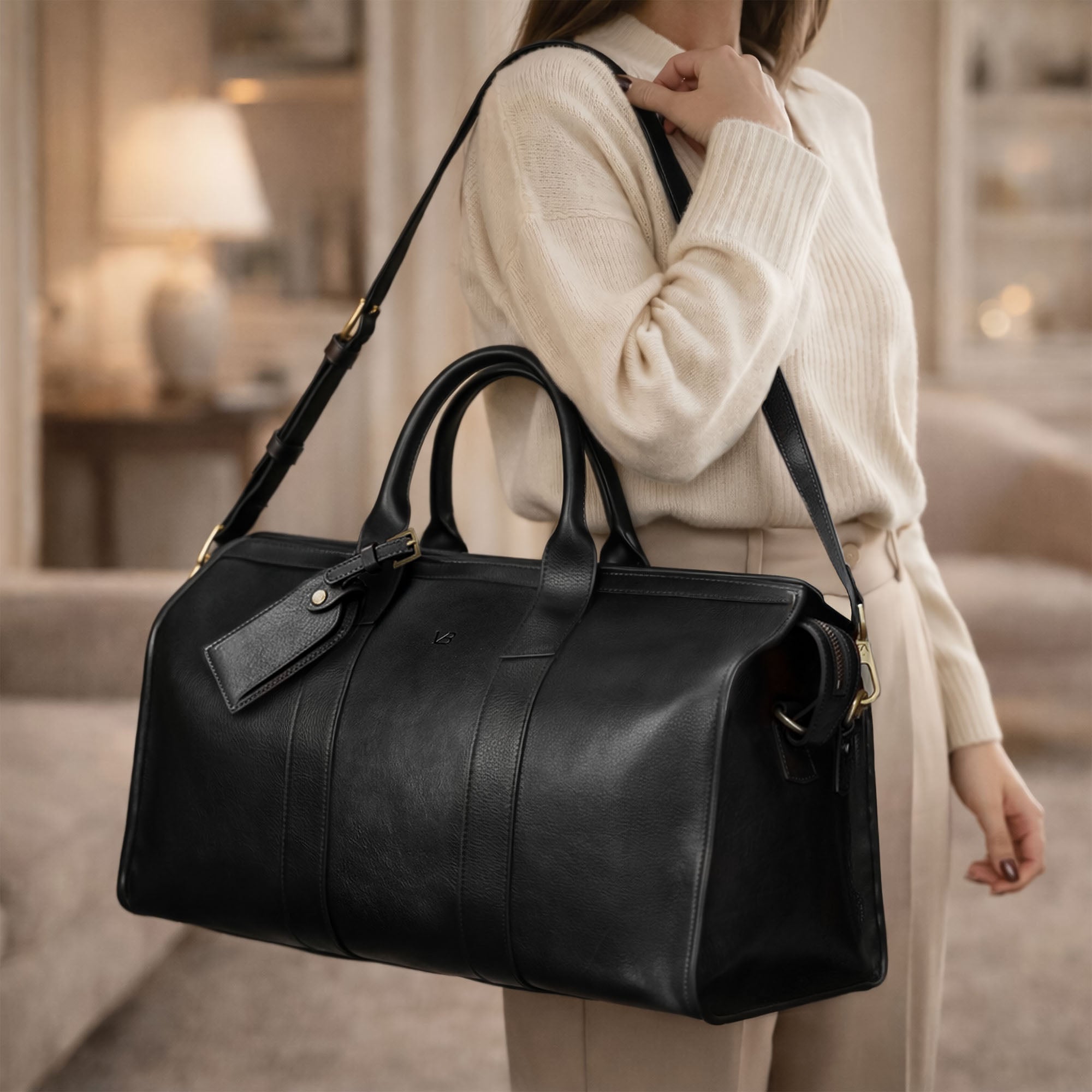
![Von Baer premium vegetable-tanned leather women's weekend bag, featuring an elegant shoulder strap and designed for carry-on compliance, ideal for the modern traveler]()
Then there's the tanning process.
Vegetable tanning uses plant-based tannins instead of chromium salts. That creates thicker fibres that slowly absorb oils from your hands over time.
That's why you get those darkened handles and burnished corners people love on older leather bags.
Ageing behaves differently depending on tanning method too:
- Chrome-tanned leather often keeps the same colour but can develop surface cracking after 6-10 years of heavy flexing.
- Vegetable-tanned leather gets softer and darker, often lasting 20+ years with occasional conditioning.
Lower-grade stuff - anything labelled "genuine leather" or bonded leather - is usually scraps pressed together with adhesives. Under travel stress those can delaminate or crack within 2-4 years.
Structure matters too.
Premium weekenders usually include internal frame strips or reinforced leather base panels. That way the bag stands upright instead of collapsing into a floppy gym bag shape.
Add brass feet on the base, and suddenly you can set the bag next to a conference chair without it tipping over.
Small detail. Weirdly satisfying.
Those feet also reduce abrasion against floors, which helps the leather last longer.
![]()
Hardware should feel heavy and mechanical - not decorative.
Look for brass or stainless steel zips with 8-10 mm teeth. They handle constant opening while the bag is packed tight.
Cheap plated hardware often fails at the zip stop. Usually at the worst moment possible... like right before boarding.
Also worth knowing: zip failures spike when bags exceed 85-90% capacity, because internal pressure spreads the teeth.
Packing works best with simple structure:
- One large central compartment
- Two internal slip pockets for laptops or folders
- Shoe sleeves or dust bags
Most travellers pack them like this: Blazer laid flat along the bag length. Shirts folded around it. Shoes at the base anchoring weight.
So yeah - simple formula: full-grain vegetable-tanned leather, reinforced base structure, heavyweight hardware.
Those three things make a bag that honestly looks better after years of travel.
Choose this if quiet luxury and boardroom presence matter to you. Skip it if you want the rigid organisation and spinner mobility of a suitcase.
(Learn more about the principles of quiet luxury in this article).
Best for the Agile King Warrior: The Expandable 3-in-1 Travel Hybrid
![]()
Some trips just refuse to cooperate.
Cobblestone streets. Train platforms. Tight connections where you suddenly have to run across a terminal.
Spinner luggage feels amazing... until suddenly it doesn't.
Gear designers call this mode transition friction. Basically the moment when a bag built for one environment completely fails in another.
Airports are designed for wheels.
Old cities absolutely are not.
Buyer Logic
-
3-in-1 convertible travel bag (backpack / messenger / briefcase) - adapts to airports, taxis, and walking commutes.
-
Expandable leather travel backpack (21-28 L capacity) - flexible enough for short or extended trips.
-
Hidden harness system with stowable straps - looks professional during meetings.
-
Ballistic-nylon reinforced leather hybrid construction - extremely durable without looking tactical.
![]()
The Deep Dive
Hybrid bags exist because global travel is unpredictable.
Roll a spinner through an airport - perfect.
Roll it across cobblestone streets in Rome, Prague, Lisbon, or parts of London... suddenly those tiny wheels feel fragile and loud.
Cobblestones were built centuries before wheeled luggage existed. The constant micro-impacts wear wheels down fast and send vibration up through the handle.
A 3-in-1 hybrid bag avoids that problem by switching modes.
Backpack straps for longer walks. Messenger carry for quick transitions. Briefcase carry for professional settings.
Each mode actually fits a specific distance:
-
Backpack mode: walking more than 800 metres
-
Messenger mode: short hops like taxi - train - office
-
Briefcase mode: client meetings or hotel arrival
![Von Baer 10x leather expandable travel large backpack]()
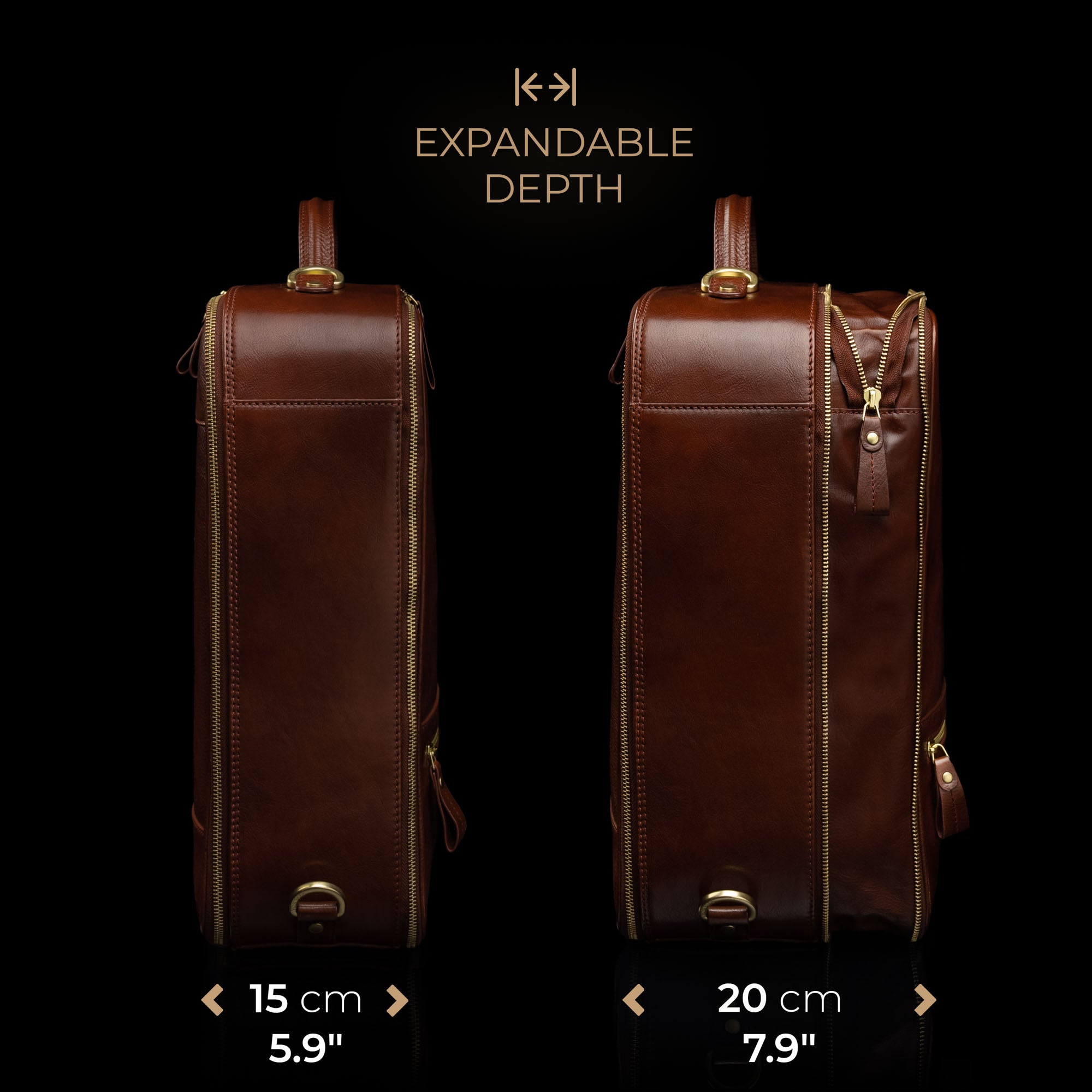
Capacity usually sits around 21-28 litres, expanding with perimeter zips or gusset panels.
That realistically fits:
- Laptop + charger
- Two shirts
- Lightweight shoes
- Compact toiletry pouch
- Documents
That size also stays under most airline personal-item limits (45.5 x 35.5 x 20.5 cm (18 x 14 x 8 inches)).
Tech storage matters here too.
Look for padded laptop sleeves for 15.6-inch devices, plus tablet pockets and cable organisers.
Good padding lands around 8-12 mm EVA foam, which protects electronics without turning the bag into a brick.
Material design is interesting.
![Von Baer 10x spacious leather laptop travel bag for women, packed with a suit and items.]()
The best versions combine full-grain leather panels with 1050D ballistic nylon reinforcement.
Ballistic nylon - originally developed during World War II for military flak jackets - is ridiculously abrasion resistant.
Testing shows 1050D ballistic nylon survives 1,000-1,500 rub abrasion cycles, far higher than most fashion fabrics.
That's why these bags survive things like:
- train floors
- taxi boots
- rough pavement
...while still weighing around 1.6-2.0 kg total.
One little detail most people overlook: strap storage.
Good hybrid bags hide backpack straps inside zipped rear panels.
Otherwise those straps dangle everywhere and catch on chair arms, escalators, aeroplane seats - basically anything nearby.
That small design choice massively improves day-to-day usability.
At the end of the day these bags prioritise mobility and adaptability, not rigid packing structure.
Choose this if your trips involve walking-heavy cities or tight connections. Skip it if you want structured packing and wrinkle protection for suits.
Best for Corporate Litigators & Formal Events: The Luxury Leather Garment Bag
![]()
Here's the blunt truth.
You can solve a lot of travel problems with a little time.
Wrinkled suits are not one of them.
Tailored garments rely on canvas interlining, structured shoulders, and precisely pressed seams. When those structures crease under pressure... you usually need professional pressing or steaming to fix them.
Which is not helpful at 7:30 a.m. before a client meeting.
Buyer Logic
-
Leather foldable garment bag with hanger system - protects suits without hard creases.
-
Tri-fold carry-on garment bag (55 cm width) - sized to fit overhead lockers.
-
Semi-rigid leather garment case with internal compression panels - prevents crushing during transit.
![Von Baer Grand Large Full-Grain Leather Garment Travel Bag (Brown, Man Wearing, Sunset Marina)]()
The Deep Dive
Garment bags work differently from normal luggage.
Instead of folding clothes into tight stacks, they use long folding panels that mimic how suits naturally hang.
For business travel, the sweet spot is the tri-fold carry-on garment bag.
Unfolded, the interior usually measures around 100-110 cm long. That comfortably fits most suit jackets up to 44R or 46R sizes.
Fold it up and the bag compresses to roughly 55 x 40 x 20 cm, which lines up with most airline carry-on limits.
Now the real issue: overhead lockers.
Thin nylon garment bags collapse easily if another passenger jams a roller suitcase on top.
Pressure points show up right where you don't want them:
- shoulder pads
- lapels
- sleeve seams
A full-grain leather exterior with internal frame reinforcement creates semi-rigid protection so those areas stay intact.
Inside you'll usually find:
- Removable hanger hooks
- Compression straps for garments
- Accessory pockets for ties, belts, cufflinks
- Separate shoe compartments
Some models also include padded laptop sleeves, which lets the bag double as your only carry-on for short trips.
Weight usually lands around 2.5-3.5 kg - heavier than nylon, yes. But the structure protects the clothing.
And for people whose credibility shows up in their wardrobe - lawyers, bankers, diplomats - that reliability matters more than saving a kilogram.
Garment bags basically trade packing volume for perfect clothing preservation.
Choose this if suits absolutely must arrive flawless. Skip it if you mostly travel with casual clothing or need maximum packing space. Compare other top leather garment bags for executives here.
Essential Companion Bags: Integrating Briefcases & Laptop Bags
![]()
Even with perfect luggage, things fall apart if your personal item becomes a chaotic junk drawer.
Chargers tangled. Documents sliding around. Boarding passes disappearing exactly when you need them.
Experienced travellers treat their personal item like the operational control centre of the trip.
Everything you might need mid-flight or between meetings lives there.
Buyer Logic
-
Triple-gusset leather briefcase - organised document storage with expandable sections.
-
Slim leather laptop bag with luggage pass-through strap - slides securely over suitcase handles.
-
Lockable document case with brass closures - protects confidential files.
The Deep Dive
One feature frequent travellers quietly love: the rear luggage pass-through strap.
It's a horizontal sleeve that slides over your suitcase handle so the briefcase rides on top.
Without it the bag constantly slips sideways while you're walking.
Which becomes surprisingly annoying when you realise most travellers walk 1-2 kilometres inside large hub airports.
Small problems become big problems over that distance.
![von baer city large leather mens laptop bag for work brown with laptop compartment]()
Inside the bag, structure matters.
Triple-gusset briefcases divide the interior into three expanding sections:
- Laptop sleeve
- Document compartment
- Accessory organiser
Each section expands roughly 3-5 cm thick, which keeps documents flat instead of crushed.
Laptop protection should use suspended sleeves.
Basically the laptop sits 1-2 cm above the base of the bag so drops don't transfer impact directly to the device.
Padding usually runs 8-10 mm EVA foam, which is enough for normal travel bumps.
Hardware matters too.
Look for rigid leather frames and brass feet on the base so the briefcase can stand upright beside a desk or chair.
And the zips? Stick with YKK self-healing coil zips or metal designs.
Good zips are tested for 5,000-10,000 open/close cycles, which translates to several years of daily use.
When all those pieces come together you get a personal item that delivers stable stacking, organised storage, and discreet security.
Choose structured leather briefcases if your meetings demand polished organisation. Skip them if you prefer ultra-light minimalist tech pouches.
If you're still not sure about the size differences, we compare carry-ons vs personal items here.
You can also browse our collection of briefcases with trolley sleeves here.
Business Luggage Buying Guide: Key Features for the Elite Professional
![]()
Internal Storage & Smart Organisation
Packing efficiency isn't really about space.
It's about structure.
Old-school suitcases rely on elastic tie-down straps, which let clothes shift during transit.
Better designs use zipped divider panels, compression sections, and dedicated sleeves.
Why it matters comes down to simple physics: luggage gets shaken constantly during travel. If clothes aren't contained, they migrate around the suitcase. That creates wrinkles and wastes space.
Compression panels alone can reduce garment volume by roughly 15-25%.
For business travel, good interior layouts include:
- Padded laptop sleeves for 15-16 inch devices
- Garment compression panels for shirts or jackets
- Separate antimicrobial-lined shoe pockets
- Cable organisers and document sleeves
Lining fabric matters more than people think too.
Cotton canvas, microfibre suede, or taffeta linings resist tearing much better than thin polyester.
They're also quieter when you move items around - nice when you're digging through a bag in a quiet conference room or aeroplane cabin.
Material Quality & Longevity
The material you choose basically decides whether the bag lasts three years or fifteen.
At the top end sits full-grain vegetable-tanned leather.
Because the natural fibre structure stays intact, it resists tearing and cracking much better than corrected leather.
Over time sunlight and handling create patina - gradual darkening and tonal shifts.
With basic conditioning every 6-12 months, well-made leather luggage often lasts 20-30 years.
Other structural materials include:
-
Polycarbonate shells - strong impact-resistant thermoplastic also used in aircraft windows and safety equipment.
-
Ballistic nylon (1050D) - extremely abrasion-resistant fabric originally developed for military gear.
-
Aluminium frame construction - rigid, crush-resistant frames used in high-end luggage systems.
Hardware matters just as much.
The most durable components are solid brass, stainless steel, and aircraft-grade aluminium.
Across luggage repair studies, the three most common failure points are always the same:
- Wheels
- Telescoping handles
- Zips
So good brands spend most of their engineering effort there - not just on exterior styling.
Personalisation & Gifting
Luxury luggage tends to become part of someone's professional identity.
Small touches like blind embossing, monogramming, or custom leather tags turn a bag from generic gear into something personal.
Most monograms are applied through heat embossing into vegetable-tanned leather, leaving a subtle impression that darkens slightly over time.
Historically this started for a practical reason.
Back in the late 19th century, rail and steamship travellers moved around with massive trunks handled by porters. Monograms helped identify which trunk belonged to which passenger.
Today it's partly symbolic.
Because of their durability, leather travel bags often mark big career moments - promotions, partnership announcements, executive roles, retirement gifts.
And honestly... a well-made leather bag can easily stick around for a decade or more of professional travel.
Not many work accessories age alongside your career like that.
FAQs
What is the difference between a standard carry-on and an executive business carry-on?
Executive carry-ons focus on work functionality first.
You'll usually see things like:
- Dedicated laptop compartments
- Document sleeves
- Rigid structural protection
- Materials like leather, aluminium, or matte polycarbonate
Holiday luggage tends to prioritise light weight, colourful shells, and expandable packing space.
Great for holidays.
Less ideal when you're travelling for meetings.
How do I keep suits from wrinkling in business luggage?
If possible, use garment bags with hanger systems.
When you're stuck using a standard suitcase, a lot of stylists and frequent travellers swear by the bundle packing technique.
Here's the basic idea:
- Lay the jacket flat inside the suitcase
- Fold the shoulders inward gently
- Wrap the trousers around the jacket body
- Place shirts around the outer layer
This spreads pressure evenly and cuts down crease lines significantly. (For a step-by-step guide, learn how to pack a suit into your carry-on here).
Are spinner wheels or travel holdalls better for business travel?
Spinner luggage wins inside airports with smooth floors.
Biomechanics studies show rolling luggage can reduce shoulder strain by over 60% compared with carrying duffel-style bags during long walks.
But leather holdalls still have advantages in crowded overhead lockers, small aircraft, and rough urban streets.
A lot of frequent travellers eventually own both and pick depending on the trip.
Why is direct-to-consumer pricing important for luxury luggage?
Traditional luxury retail has multiple pricing layers:
- Manufacturer - wholesale distributor
- Distributor - retail store
- Retail store - customer
Each step adds markup.
By the time a luxury bag hits a storefront, the original manufacturing cost may represent only 20-30% of the final retail price.
Direct-to-consumer brands skip those middle layers.
That usually means the same price point can fund better leather, stronger hardware, and longer warranties instead of retail overhead.
So as a buyer, you often end up with higher-grade materials for the same price compared with traditional department-store luxury brands.






Your email address will not be published.